
Rochester Busted Mugshots
Rochester sits at the center of it all. It is the county seat. It is also Olmsted County's biggest city, home to 121,395 people at the 2020 Census. The Rochester Police Department covers incidents inside the city limits. The Olmsted County Sheriff's Office is separate. It handles county-wide work plus contract policing for several smaller towns. The split matters. A Rochester police bulletin may be the first public word on an incident, but it was never meant as a complete city booking list.
When a Rochester arrest lands an adult in local custody, the trail leads to the Olmsted County Adult Detention Center, known around town as the ADC. Its live in-custody list is a current detention source. It is not a city photo gallery. An entry can hold a name, booking date and time, photo date or a photo indicator, the reason for holding, a detainee description, and charges with levels. Charges listed at booking can shift later once the court process gets involved.
Where Rochester Busted Mugshots Appear
Each official channel answers a different question. RPD Police News covers selected Rochester incidents. The ADC list is the first stop for current adult custody and any booking photograph on file. The sheriff activity log can fill in incident context before a booking posts. None of them captures every Rochester arrest. A missing name could mean release, a transfer, another custody system, a juvenile matter, or just a posting delay.
| Channel | What it covers | Photo and access |
|---|---|---|
| RPD Police News | Selected police bulletins and public-safety notices | Official, event-driven; not a daily booking-photo log |
| ADC In Custody List | Adults currently shown in county detention | Official; photos are displayed when available |
| Sheriff activity log | Daily incident and call context | Official; no verified systematic photo field |
| Sheriff Media Briefs | Selected notable incidents and arrests | Official weekday news feed; not a roster |
The county updates its in-custody list daily, though that is no promise a fresh arrest shows up within a set number of hours. Older booking dates stay visible while custody continues. A released person may vanish from view. If an older saved link fails, start again from the county's in-custody landing page.
Busted in Rochester: Find a Booking
The best lookup depends on where the person sits in the process. A roster check answers present county custody. An RPD release covers selected incident details. A court case tracks a charge through hearings to its end. For the full county-wide route, including state-prison and historical paths, see the Olmsted County records hub.
- Open the official ADC list and check surname and given-name variants. Read the whole entry, including booking date, reason, description, and each listed charge.
- If the arrest appears very recent, use the official activity log or RPD Police News for event context, then check the next roster update or call the ADC about current custody.
- For a person no longer on the roster, request the appropriate county booking data or Rochester police report rather than assuming the absence answers the question.
- Use MCRO for the case path. A name-only search may not display every pending case, so a case number, citation number, or other available official identifier can be more useful.
State prison puts a person outside the local pretrial roster. Adults in state custody or state supervision belong to a different system. For that stage, use the Minnesota Department of Corrections offender search. Federal and immigration custody run on their own systems too. An ADC hold label alone will not tell you which applies.
RPD News, Then County Custody
Rochester has a two-source pattern that Byron and Stewartville lack. The city's Police News page posts bulletins, releases, and public-safety notices as events happen. It promises no daily arrest list. A photo on a police notice could be incident, department, or public-notice imagery. It may not be a booking photograph at all. The adult custody record, when one exists, lives in the county's ADC system.
A linked view of the official Rochester Police News bulletin shows the kind of public-safety page RPD uses for its releases.
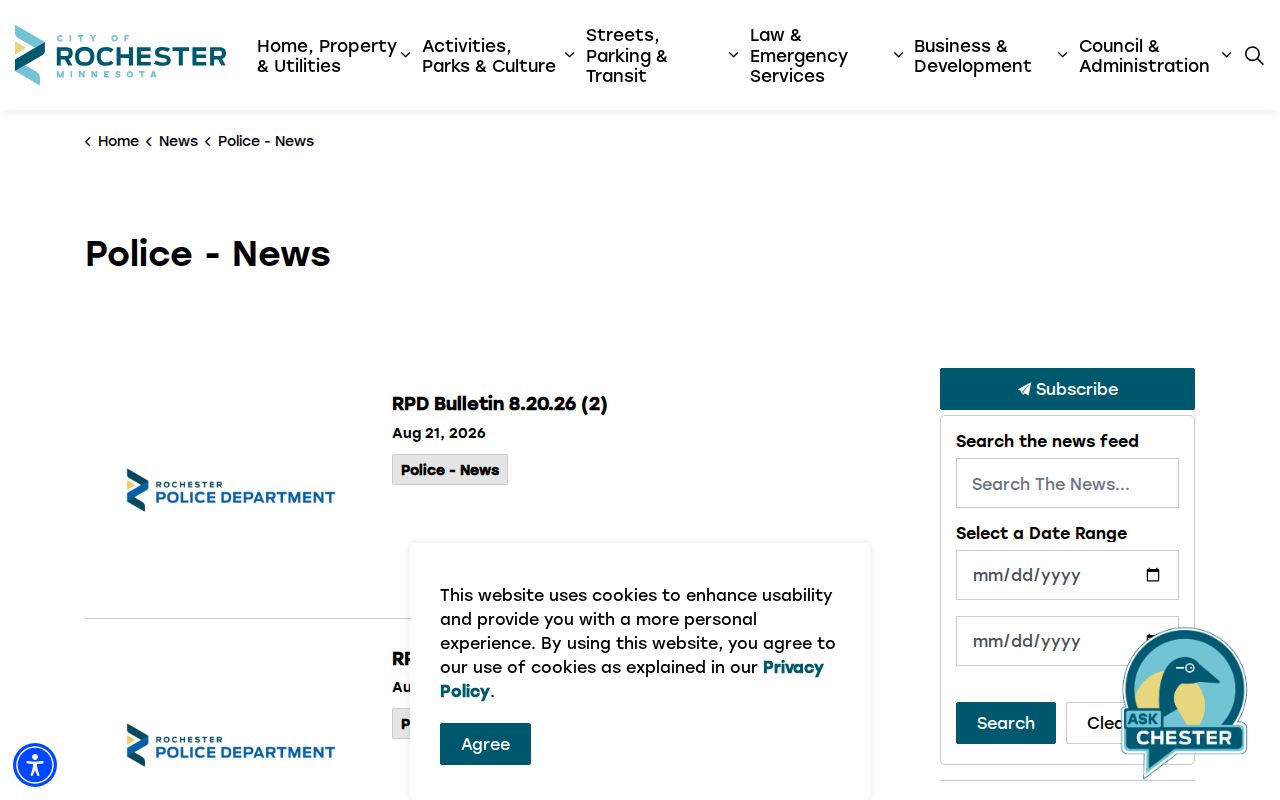
That bulletin channel gives context when RPD decides an event merits a release. It does not replace the ADC list for current custody. Never read it as a full record of Rochester arrests.
The sheriff's Media Briefs add another layer of official context. They cover selected notable incidents and arrests Monday through Friday, skipping major holidays. Weekend events get handled the following week. A brief might name an agency, a charge referral, or an ADC transport. They are prose releases, though. They are not a photo-bearing booking feed.
Rochester Arrest Record Requests
Rochester police reports and related requests go through RPD transparency and records. The city says Law Enforcement Records serves both RPD and the sheriff. For a police report, identify the Rochester incident. For a booking sheet or booking photo, give the ADC record by full name. Add the booking date or booking number if known. The files can overlap. Still, the police report and the county custody record are not the same document.
Law Enforcement Records
101 4th Street SE
Rochester, MN 55904
Records: 507-328-6811
Monday through Friday, 8:00 a.m. to 4:30 p.m., excluding holidays
Adult Detention Center
101 4th Street SE
Rochester, MN 55904-3718
Current custody: 507-328-6790
Use the jail for a current custody question, not as a stand-in for a formal records request.
No name on the live roster? The county still keeps a paper trail. File through its Data Practice Request channel. State what you want plainly: to view the record, get a copy, or both. Viewing is free. Copies run at actual cost by format, and the county promises no fixed turnaround on any single photo. Minnesota Statute 13.82, subdivision 26, treats a booking photograph as public in most cases. An open-investigation hold or another classification can still block release. Rochester's RPD records and transparency page lists the city's own official request route.
The formal request path fills gaps the roster and press bulletins leave open. When a specific record matters, ask the custodian directly how the item is classified and what a copy will cost.
Rochester Busted News and Court Follow-Up
Rochester public-safety stories surface in several local outlets. The Post Bulletin, KROC, KAAL, and KTTC all cover area arrests and criminal cases. Coverage follows the news cycle, though. Reporters lean on police releases, complaints, and court files. An article adds context, but it never replaces the roster, the custodian, or the court file itself.
Two private Olmsted County indexes also exist: Mugshots.com and Minnesota Arrests.org. Neither is a public agency. Neither is a record custodian. Their entries can go stale or attach to the wrong person. Busted Newspaper, RecentlyBooked, and Mugshots.zone carry no Olmsted section at all. Start with official sources for any Rochester matter. Treat the private sites as leads at most.
Rochester Jail Records, Past and Present
Today's jail data and yesterday's history are two different animals. The sheriff traces its first records to 1881. Its jail records go back to 1858. For earlier custody, researchers should consult the Minnesota Historical Society finding aid. It catalogs 17 Olmsted County Sheriff jail-register volumes spanning 1882 to 1987. These are paper archives. They are not a searchable gallery of historic booking photos. The History Center of Olmsted County offers another path, through old newspapers, photographs, and local context.
For a current Rochester booking, go straight to the ADC or a county data request. The city pages for Stewartville and Byron feed into the same county booking system, though their policing routes differ.
The old/new divide shapes any name search. Historical registers cover an earlier era of county custody. The live ADC list reflects only present adult detention. Neither yields a court outcome on its own. A modern request should name the date and the exact record sought. A historical inquiry starts with the finding aid, then asks the archive about access, restrictions, and copying. Different ages, different custodians, different routes.
Rochester also shows why source order counts. A police release may document an incident before any court file exists. Someone booked at the ADC can be released within hours, vanishing from the roster. When the first notice or the live list stops short, the records office and MCRO carry the question the rest of the way. A photo, a headline, or a charge line is never the full story by itself.